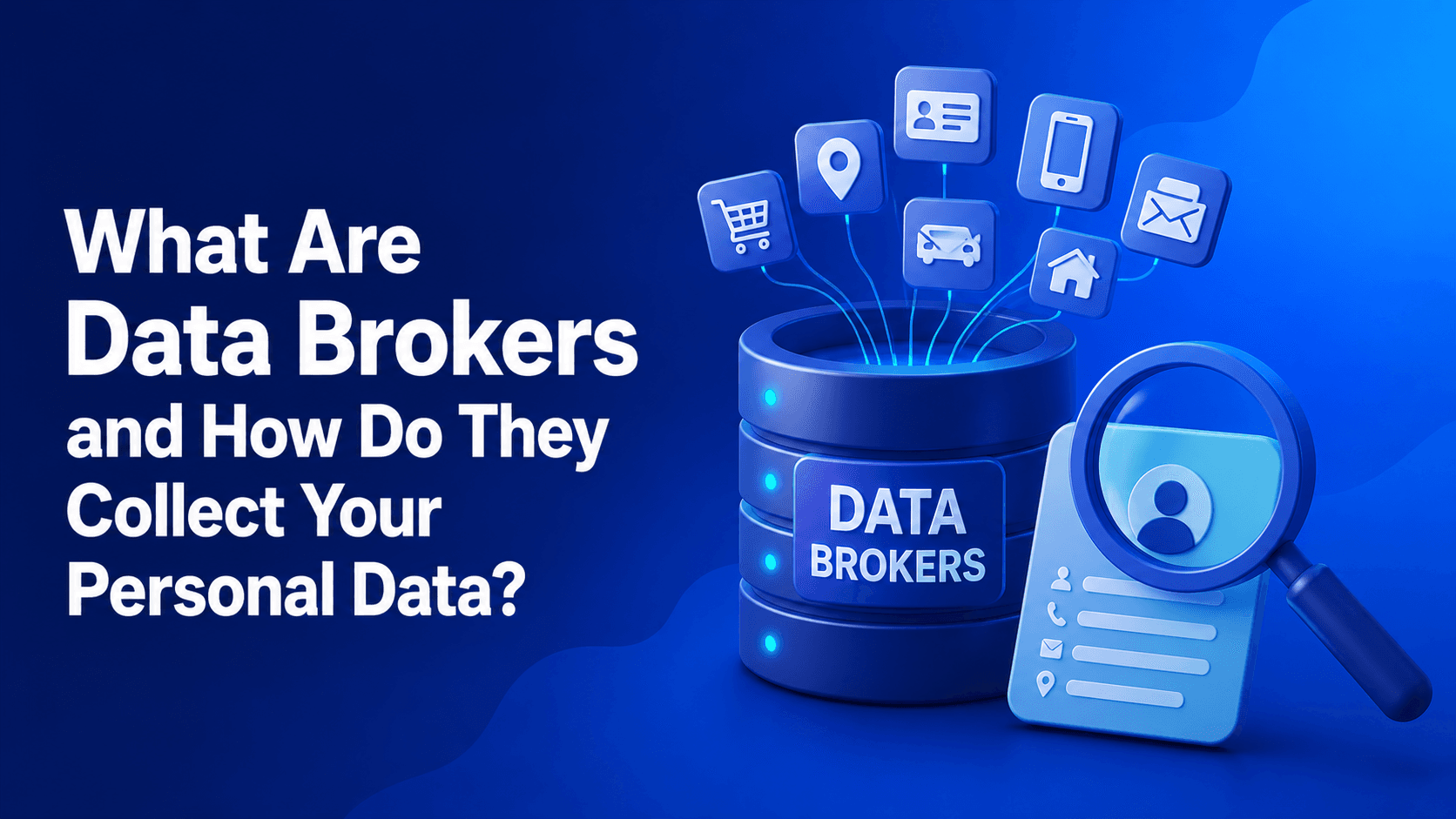
What Are Data Brokers and How Do They Collect Your Personal Data?
Data Brokers collect and combine information from multiple sources to build audience and consumer profiles. Learn where this data comes from, how it is used, and how to reduce unnecessary exposure.

Paul Jackson
Technology editor
Every day, we browse websites, shop online, install mobile apps, create accounts, and use digital services.
Each of these actions can leave behind a small digital footprint.
On its own, a single piece of information may reveal very little. But when thousands of data points are combined, they can create a surprisingly detailed profile: approximate age, interests, shopping habits, preferred brands, devices, location patterns, and other characteristics.
This is where Data Brokers come in.
Unlike social networks, search engines, or online stores, Data Brokers do not necessarily collect most of this information directly from users. Their business is largely based on obtaining data from multiple sources, combining it, analyzing it, and providing derived information or audience segments to other organizations.
Understanding how Data Brokers work helps explain why companies you have never interacted with may still have information associated with you.
What Is a Data Broker?
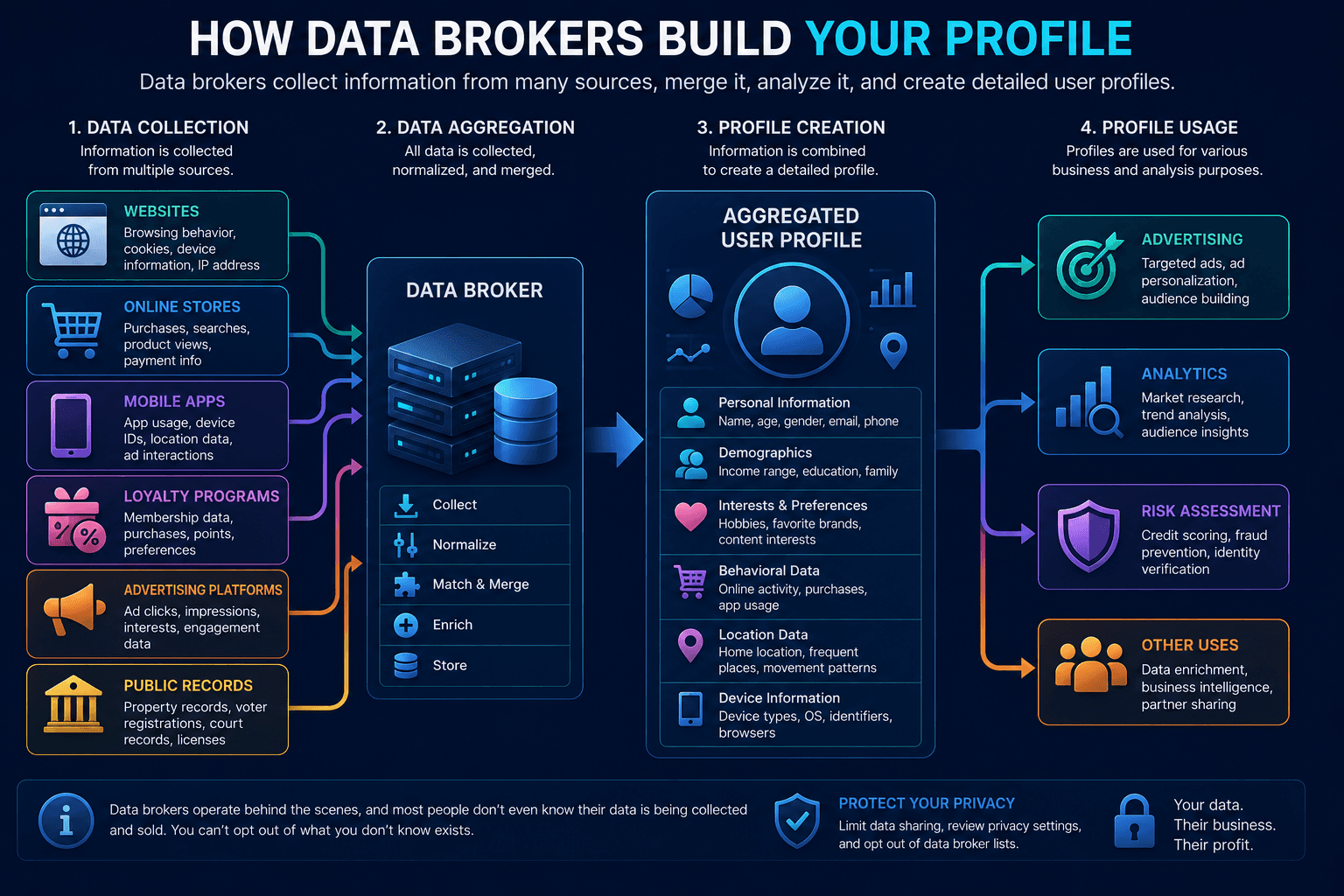
A Data Broker is a company that collects, aggregates, analyzes, and provides information about individuals or audiences to other organizations.
One important distinction is that Data Brokers often do not generate all of this information themselves.
Depending on the company and jurisdiction, data may be:
- purchased from other organizations;
- licensed from commercial partners;
- obtained from public records;
- received through data-sharing agreements;
- derived by combining existing datasets.
The real value comes from aggregation.
A single company may know only one small part of your activity. A Data Broker can combine multiple fragments into a broader profile.
The resulting data may be used for:
- advertising and marketing;
- audience segmentation;
- analytics and research;
- risk assessment;
- fraud prevention;
- personalization.
Where Do Data Brokers Get Their Information?
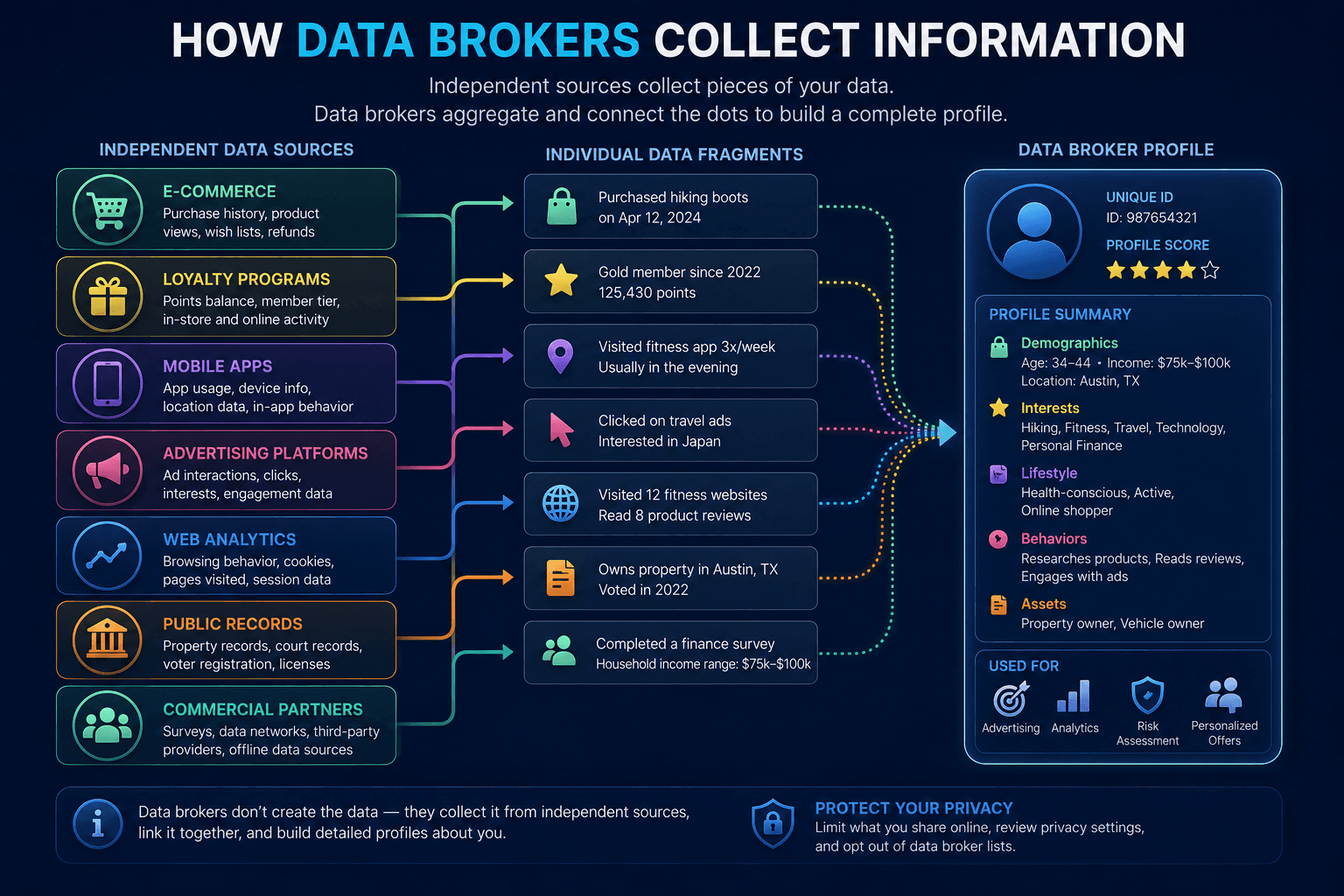
A common misconception is that one company somehow monitors everything a person does online.
In reality, different services usually have access to different pieces of information.
For example:
- an online store knows what you purchased;
- a loyalty program knows where and how often you shop;
- a mobile app knows information about your device;
- an advertising platform may know which ads or websites you interacted with;
- an analytics service knows how visitors use a particular website.
Individually, these datasets may provide limited context.
Combined, they become much more valuable.
Common data sources can include:
- e-commerce websites;
- loyalty programs;
- mobile applications;
- advertising platforms;
- web analytics systems;
- public government records;
- publicly available databases;
- commercial partners.
What Information Can Data Brokers Collect?
The contents of a Data Broker profile depend entirely on the available sources.
Some profiles may contain only basic contact information, while others can include demographic, device, behavioral, and commercial data.
Contact Information
This may include:
- name;
- email address;
- phone number;
- postal address.
Demographic Information
Depending on the source, a profile may include or infer:
- approximate age;
- gender;
- region;
- language.
Device Information
Data associated with devices may include:
- advertising identifiers;
- device types;
- operating systems;
- browsers.
Behavioral and Commercial Data
Data Brokers may also work with information or inferred categories related to:
- interests;
- purchase history;
- product categories;
- shopping preferences;
- marketing segments.
This does not mean that every Data Broker has all of these details about every person.
The amount and accuracy of the information depend on the datasets available to that particular company.
| Category | Examples |
|---|---|
| Contact Information | Name, email address, phone number, postal address |
| Demographic Information | Approximate age, gender, region, language |
| Device Information | Advertising identifiers, device types, operating systems, browsers |
| Behavioral and Commercial Data | Interests, purchase history, product categories, shopping preferences, marketing segments |
Who Uses Data Broker Information?
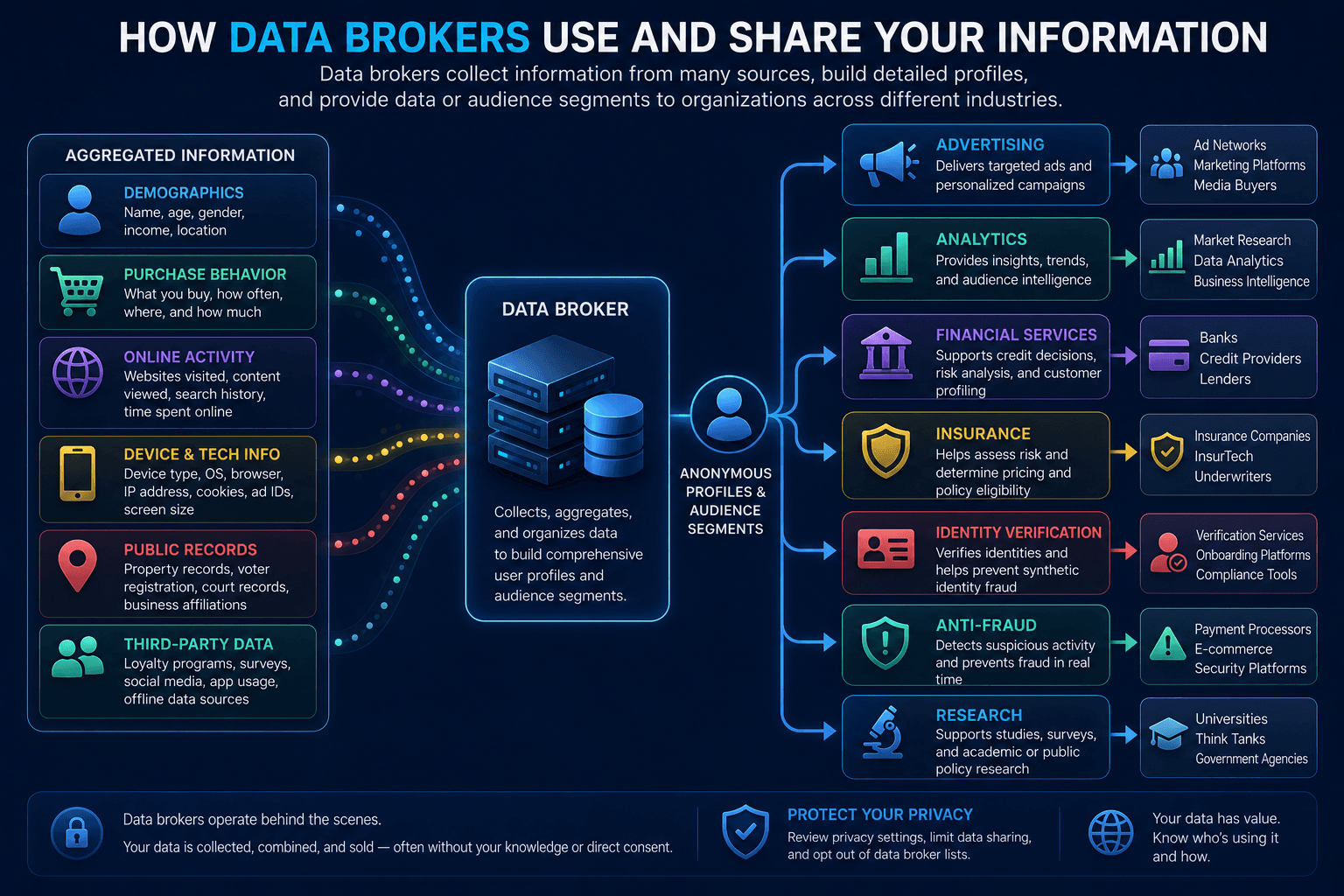
Aggregated data is useful across many industries.
Depending on the type of information and applicable regulations, customers may include:
- advertising platforms;
- analytics companies;
- financial institutions;
- insurance companies;
- identity verification services;
- anti-fraud platforms;
- research organizations.
The purpose varies considerably.
A marketing company may use audience segments to improve advertising relevance.
An anti-fraud provider may use certain data points as part of a broader risk assessment.
A research organization may work with aggregated datasets to study consumer behavior or market trends.
The exact use depends on the provider, customer, dataset, and applicable privacy laws.
Are Data Brokers Legal?
Data Broker activity is regulated differently around the world.
Depending on the jurisdiction and type of data, processing may be based on factors such as:
- user consent;
- publicly available information;
- contractual or commercial relationships;
- other legal grounds recognized by local law.
Privacy rights also vary by location.
In some jurisdictions, individuals may have rights to:
- request access to certain personal data;
- correct inaccurate information;
- object to certain types of processing;
- opt out of some data sharing or sale;
- request deletion under applicable conditions.
Elsewhere, these protections may be more limited.
As a result, whether a specific Data Broker practice is permitted cannot be answered without considering the type of data, how it was obtained, how it is used, and which laws apply.
What Data Brokers Usually Do Not Do
Data Brokers are sometimes portrayed as companies that secretly hack accounts or intercept private communications.
That is not an accurate description of the typical Data Broker business model.
Legitimate Data Brokers generally do not need to:
- hack user accounts;
- steal passwords;
- read private messages;
- decrypt HTTPS traffic.
Their business is primarily based on acquiring, combining, analyzing, and distributing data that has already been collected or made available through other sources.
The privacy concern is therefore often not one dramatic piece of stolen information.
It is the ability to connect many ordinary pieces of data into a much more detailed profile.
Can You Remove Your Information From Data Broker Databases?
Completely preventing personal information from reaching Data Brokers can be difficult.
Using websites, apps, loyalty programs, online stores, and other digital services continuously creates new data.
However, users can reduce the amount of information available for aggregation.
Useful steps include:
- publishing less personal information publicly;
- reviewing privacy settings on important accounts;
- using different email addresses for different purposes;
- reviewing consent and data-sharing options;
- limiting unnecessary app permissions;
- opting out of third-party data sharing where available.
Some Data Brokers also provide mechanisms for accessing, correcting, opting out of, or deleting information.
The availability and scope of these options depend on the provider and local privacy regulations.
Can a VPN Reduce Your Digital Footprint?
A VPN cannot delete information that Data Brokers already have.
It operates primarily at the network layer.
A VPN service such as WhoVPN can help reduce direct exposure of certain network information by:
- replacing your public IP with the VPN server’s IP;
- routing supported traffic through the VPN tunnel;
- handling DNS through the intended VPN configuration.
This can improve network privacy, particularly on untrusted networks.
However, a VPN does not prevent every form of tracking.
Websites and applications may still identify or associate activity through:
- accounts;
- cookies;
- Browser Fingerprinting;
- advertising identifiers;
- Local Storage;
- user behavior.
A VPN should therefore be treated as one privacy layer rather than a tool that removes an existing digital identity.
Why Use Isolated Browser Profiles?
Part of a user’s digital footprint exists inside the browser itself.
Browser sessions can contain:
- Cookies;
- Local Storage;
- Browser Cache;
- login sessions;
- site permissions;
- other locally stored data.
If several independent browser environments are required, keeping this data separated can prevent one profile’s local state from automatically carrying over into another.
In WadeX, browser profiles use isolated environments so that Cookies, Local Storage, Browser Cache, and other profile data can remain separated between profiles.
This type of isolation addresses browser-level session separation.
It does not remove information that Data Brokers or other companies have already collected from external sources.
| Parameter | Shared Browser Environment | Isolated Profiles |
|---|---|---|
| Browser structure | One shared browser profile | Profile A, Profile B, and Profile C |
| Cookies | Shared in one environment | Separate for each profile |
| Local Storage | Shared in one environment | Separate for each profile |
| Cache | Shared in one environment | Separate for each profile |
| Sessions | Shared in one environment | Separate for each profile |
How to Reduce the Amount of Data Collected About You
There is no single switch that eliminates a digital footprint.
A more realistic approach is to reduce unnecessary data exposure at several levels.
For example:
- share less personal information publicly;
- review privacy settings and permissions;
- remove unused accounts and applications;
- limit unnecessary advertising personalization;
- use separate identities or email addresses where appropriate;
- use a VPN when network privacy matters;
- keep independent browser activities separated when necessary;
- use available Data Broker opt-out or deletion mechanisms.
The objective is not complete invisibility. It is reducing how much unnecessary information can be collected, connected, and reused.
| Level | Action |
|---|---|
| Public Information | Share less personal information publicly |
| Accounts | Review privacy settings and remove unused accounts |
| Apps | Review permissions and remove unused applications |
| Advertising | Limit unnecessary advertising personalization |
| Network | Use a VPN when network privacy matters |
| Browser | Keep independent browser activities separated when necessary |
| Data Brokers | Use available opt-out or deletion mechanisms |
Conclusion
Data Brokers rarely learn everything about a person from one source.
Their value comes from combining information that originally existed in separate places.
An online store may know your purchases. An app may know your device. An advertising platform may understand some of your interests. Public records may provide additional information.
When these datasets are linked, the resulting profile can become significantly more detailed than any individual source.
Completely eliminating your digital footprint is unrealistic, but reducing unnecessary exposure is possible. Reviewing privacy settings, limiting data sharing, using network privacy tools, and separating browser environments can all reduce the amount of new information available for aggregation.
The key is understanding that online privacy is not controlled by a single setting or tool. It depends on how much information is exposed across the entire digital environment.