Deep Packet Inspection (DPI): How Modern Traffic Analysis Works
Learn how modern Deep Packet Inspection (DPI) analyzes encrypted traffic using packet patterns, TLS handshakes, and metadata without decrypting HTTPS content.

Paul Jackson
Technology editor
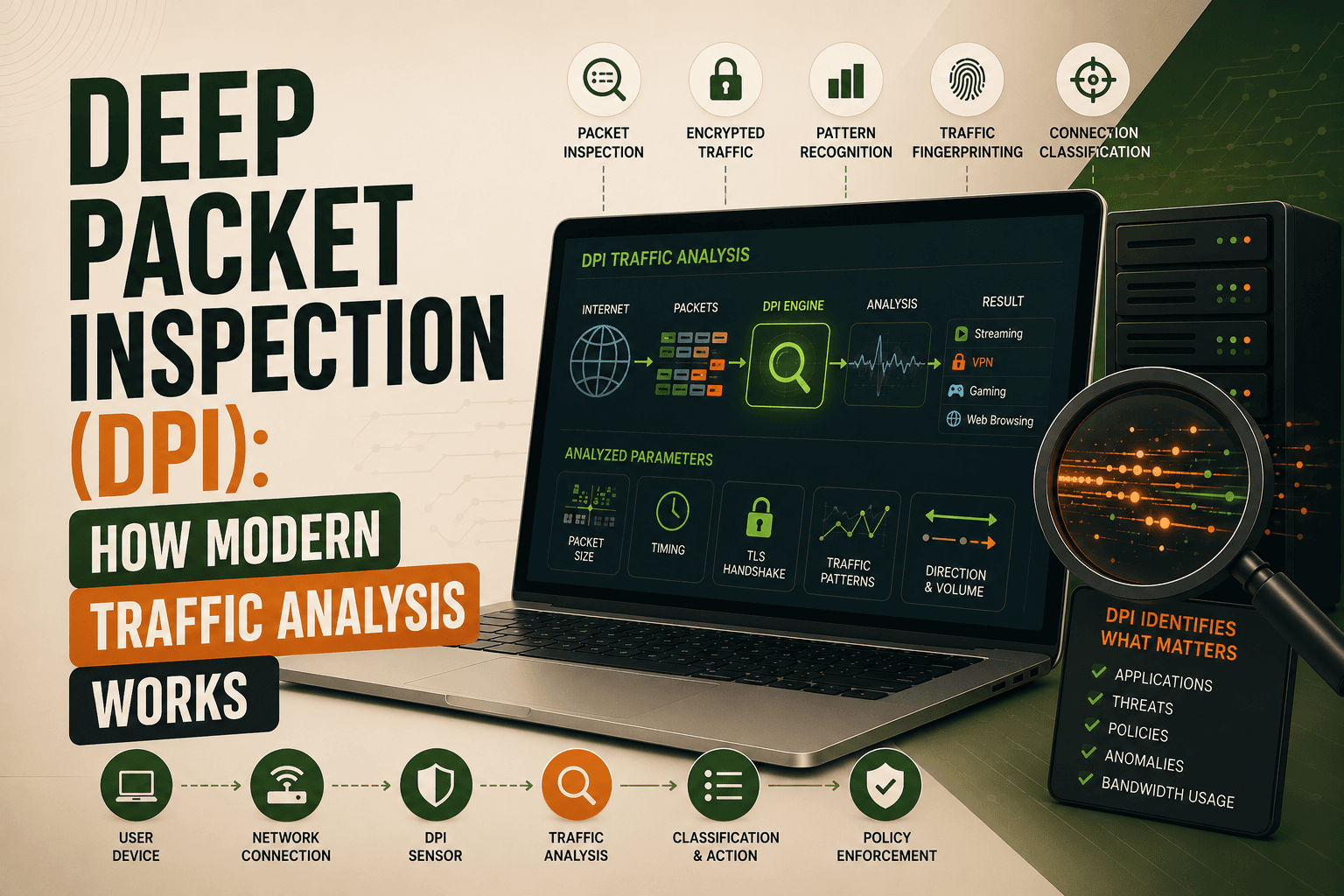
For many people, Deep Packet Inspection (DPI) is a technology that simply reads network packets and inspects their contents. That description used to be fairly accurate, but it no longer reflects how most DPI systems work today.
The vast majority of websites now use HTTPS, which means the contents of network traffic are protected by TLS encryption. Without access to the encryption keys, inspecting that data isn’t practical. As a result, modern DPI solutions focus on something different—the characteristics of the connection itself.
Packet sizes, transmission timing, TLS handshakes, and traffic patterns often reveal enough information to classify a connection without ever decrypting its contents.
That’s why Deep Packet Inspection remains one of the primary technologies used for traffic management, VPN detection, and network security.
What Is Deep Packet Inspection?
Deep Packet Inspection (DPI) is a network traffic analysis technology that examines connections and applies rules based on their characteristics.
Today, DPI is used in many environments, including:
- Internet service providers;
- enterprise networks;
- government filtering systems;
- CDN platforms;
- anti-bot and anti-fraud solutions.
The name Deep Packet Inspection can be misleading. While the technology is still capable of inspecting unencrypted traffic, modern implementations often rely far more on connection metadata than packet contents.
Instead of asking “What information is being transmitted?”, they ask “What kind of connection is this?”
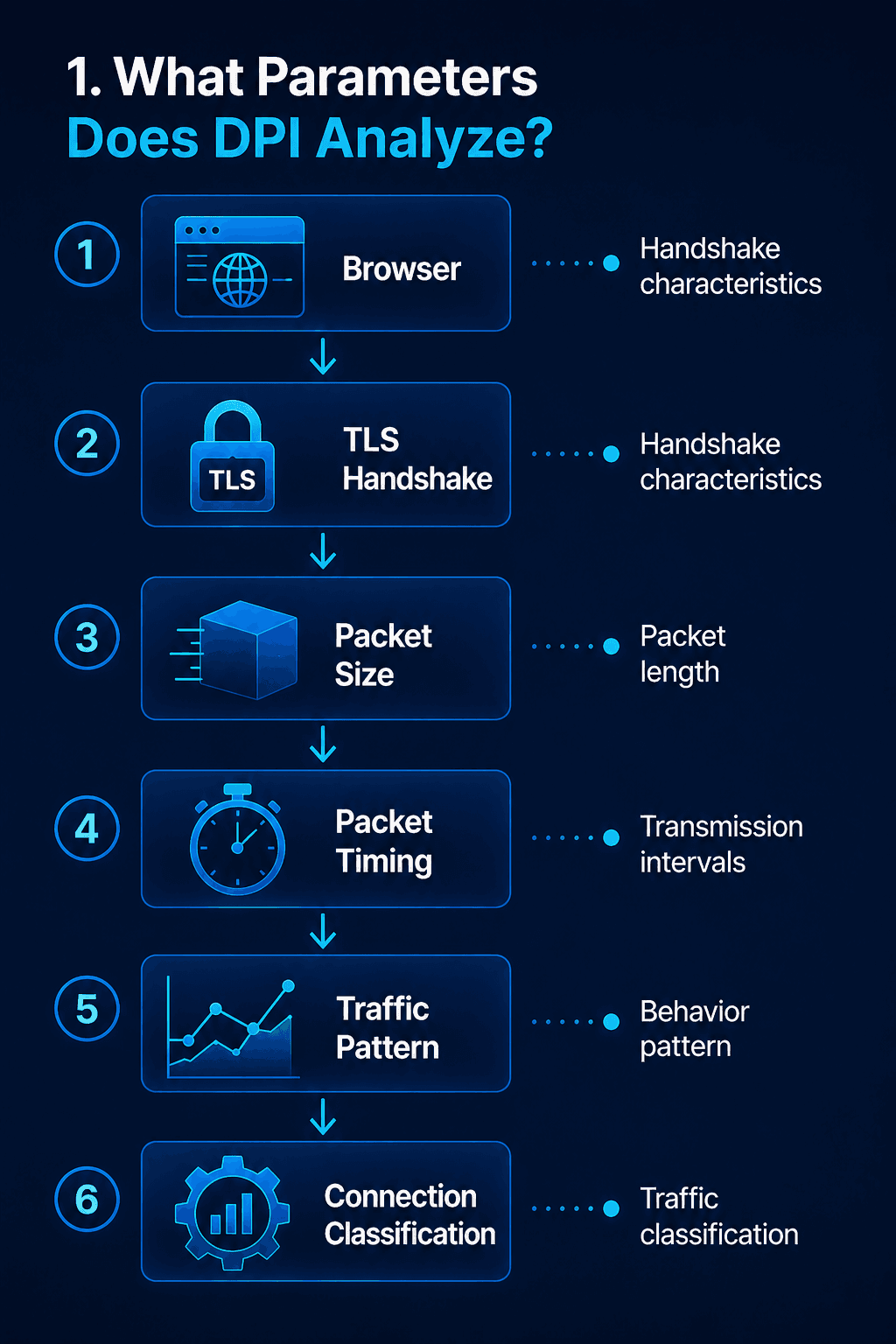
Depending on the implementation, a DPI system may analyze:
- the connection establishment sequence;
- packet sizes;
- packet timing;
- TLS Handshake characteristics;
- traffic direction and flow patterns.
In practice, DPI is usually evaluating how a connection behaves, rather than reading the information carried inside it.
Why HTTPS Doesn’t Hide Everything
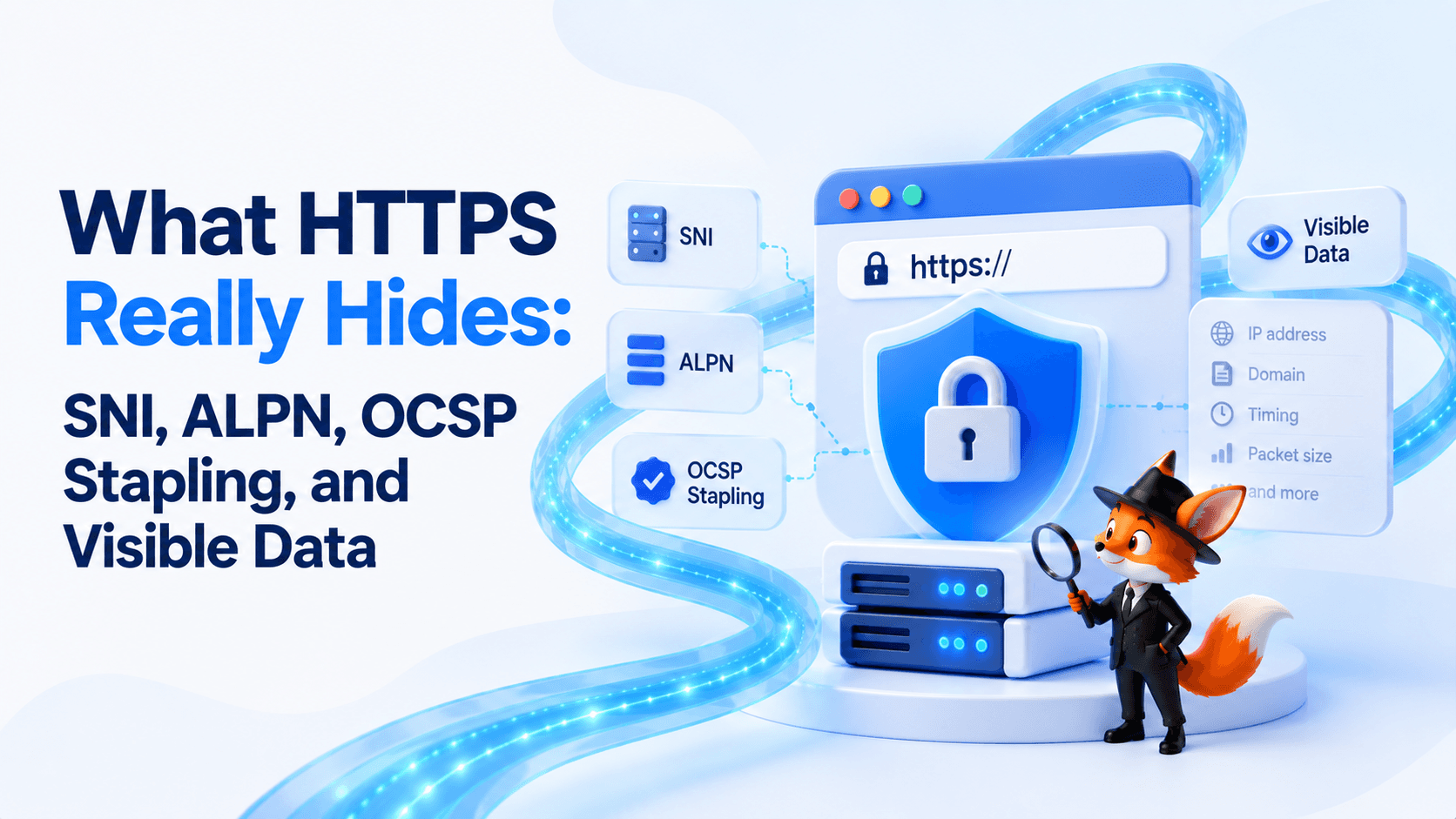
HTTPS does an excellent job of protecting data in transit. When a website uses TLS, third parties cannot read page contents, passwords, messages, or files exchanged between the browser and the server.
However, encryption does not hide every aspect of a connection.
A DPI system can still observe information such as:
- packet frequency;
- packet sizes;
- connection duration;
- TLS Handshake behavior.
A useful analogy is watching two people talk through soundproof glass. You can’t hear the conversation, but you can still see how long it lasts, how often they interact, and how they behave.
Modern DPI systems work in much the same way. Instead of reading encrypted traffic, they analyze the metadata surrounding it.
How DPI Detects VPN Traffic
Every VPN protocol has its own network characteristics. Even when the traffic is fully encrypted, the way a connection is established and maintained often differs from ordinary HTTPS traffic.
For example, OpenVPN typically produces a recognizable handshake sequence along with characteristic packet sizes and transmission patterns. Over time, these traits become familiar to traffic analysis systems.
WireGuard takes a different approach. Built around a lightweight UDP protocol, it creates a distinct traffic profile of its own. That doesn’t automatically make WireGuard easy to detect, but many DPI implementations are capable of incorporating these characteristics into their classification models.
It’s also worth remembering that modern DPI systems rarely rely on a single indicator. Instead, they combine multiple signals before deciding whether a connection is likely to be using a VPN.
Behavioral Analysis Has Replaced Signature Matching
Early DPI solutions relied heavily on known traffic signatures. While signature-based detection is still used, it has become only one part of a much broader analysis process.
Modern systems increasingly build behavioral models instead.
Rather than looking for one specific pattern, they evaluate how closely a connection resembles normal web browsing.
This analysis may include:
- packet exchange sequences;
- connection stability;
- transmission intervals;
- overall traffic behavior.
The more a connection deviates from typical browser traffic, the more likely it is to receive additional scrutiny.
This shift explains why modern VPN technologies focus not only on encryption, but also on making their traffic appear as natural as possible.
TLS Fingerprinting and JA3
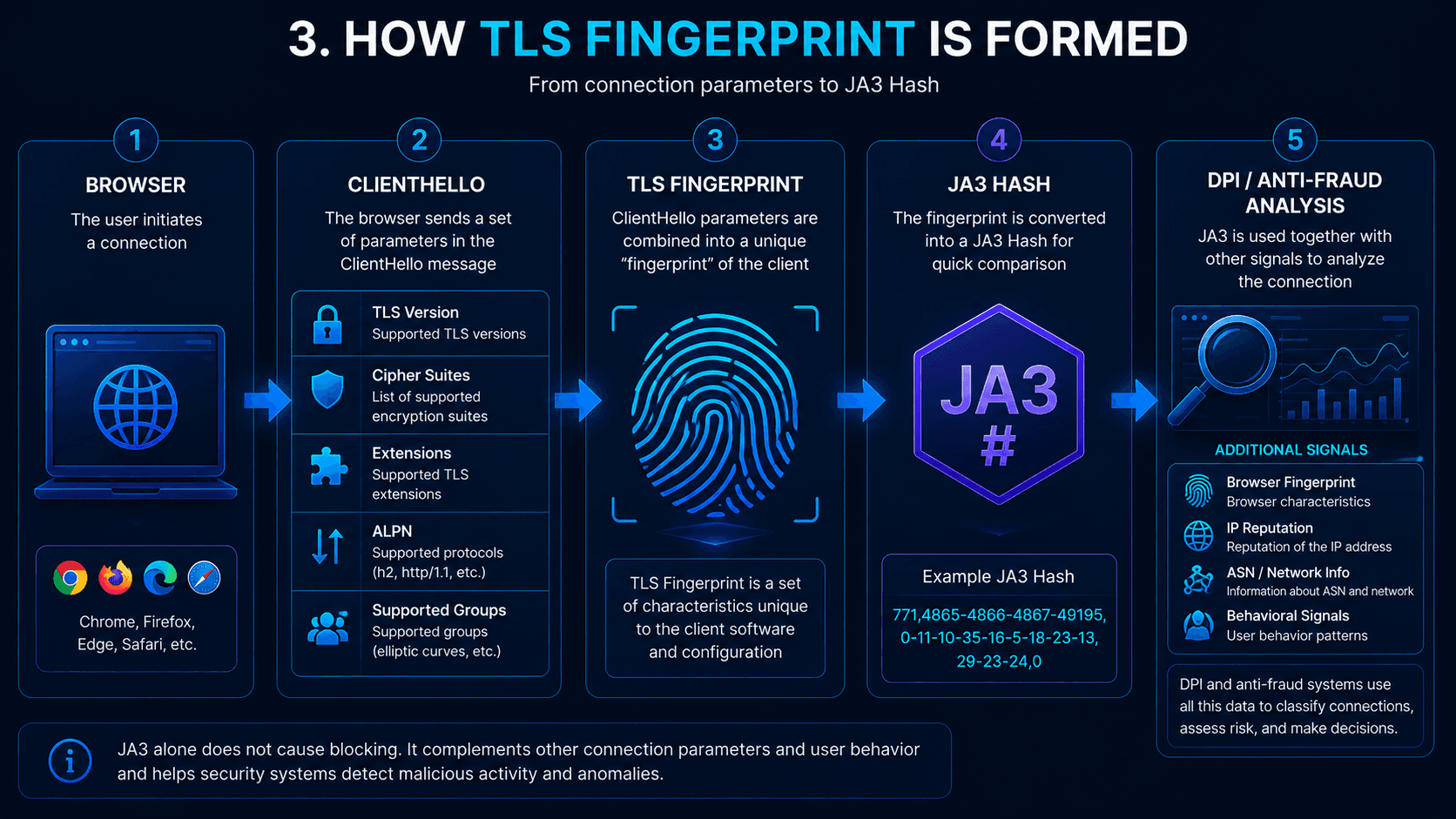
When a browser establishes an HTTPS connection, it begins by sending a ClientHello message. This message includes information such as supported TLS versions, cipher suites, extensions, ALPN settings, and other technical parameters.
Together, these values create a TLS Fingerprint—a unique profile of the TLS client.
Different browsers, operating systems, and networking libraries generate slightly different fingerprints. That makes TLS Fingerprinting a useful signal when identifying the software behind a connection.
One of the most widely used techniques for comparing these profiles is JA3. It converts the parameters from the ClientHello message into a compact hash, allowing systems to quickly compare new connections with previously identified patterns.
JA3 alone rarely triggers a block. Instead, it’s typically evaluated alongside other indicators, including traffic behavior, Browser Fingerprint, IP reputation, and user activity.
Why Modern VPNs Are Harder to Detect
VPN technology has evolved alongside DPI.
Rather than relying solely on encryption, newer protocols try to make their traffic blend in with ordinary HTTPS connections.
A good example is the Xray ecosystem.
Instead of hiding the fact that a VPN is being used, Xray focuses on making the connection appear as natural as possible.
For example:
- VLESS removes protocol-specific signatures.
- Reality makes the connection resemble a legitimate TLS session.
- Transports such as WebSocket, HTTP/2, and gRPC allow VPN traffic to fit naturally into normal web traffic.
This doesn’t make a VPN invisible, but it significantly reduces the number of obvious indicators that DPI systems can use during classification.
DPI Is Only One Part of the Detection Process
Network traffic is rarely analyzed in isolation.
Today, many websites and anti-fraud platforms combine DPI with other sources of information before making a decision.
These may include:
- Browser Fingerprint;
- User-Agent;
- ASN;
- IP reputation;
- previous connection history;
- behavioral signals.
This is why a well-configured VPN alone doesn’t always prevent additional verification. If other characteristics appear inconsistent, a website may still display a CAPTCHA, require extra authentication, or restrict access altogether.
Can You Bypass DPI?
There is no universal way to bypass every DPI implementation.
Different vendors use different detection methods, and those systems continue to evolve over time.
In practice, the goal isn’t to become invisible—it’s to reduce the number of signals that make a connection stand out.
That usually involves:
- using modern VPN protocols and transports;
- keeping network behavior consistent with the browser environment;
- choosing IP addresses with a good reputation;
- testing the connection after configuration.
Once your VPN is connected, it’s worth checking for DNS leaks, WebRTC leaks, and other configuration issues. Services like Whoer.net make it easy to verify how your connection appears from the outside.
For a complete verification process, see our VPN Privacy Checklist.
Conclusion
Deep Packet Inspection is no longer just about inspecting packet contents.
Modern DPI systems primarily analyze how a connection behaves rather than what it contains. Packet timing, TLS Handshake characteristics, traffic patterns, and other metadata often provide enough information to classify encrypted connections without decrypting them.
As a result, effective VPN technologies now focus on more than encryption alone. They aim to make encrypted traffic resemble ordinary HTTPS traffic as closely as possible, making accurate classification significantly more difficult.