What Is Xray and How It Helps Bypass Network Blocking
Learn what Xray is, how its modular architecture works with technologies like VLESS and REALITY, and why it is used on networks with DPI-based traffic filtering

Paul Jackson
Technology editor
Traditional VPN protocols still do their core job well: they create an encrypted tunnel and protect traffic between your device and a VPN server.
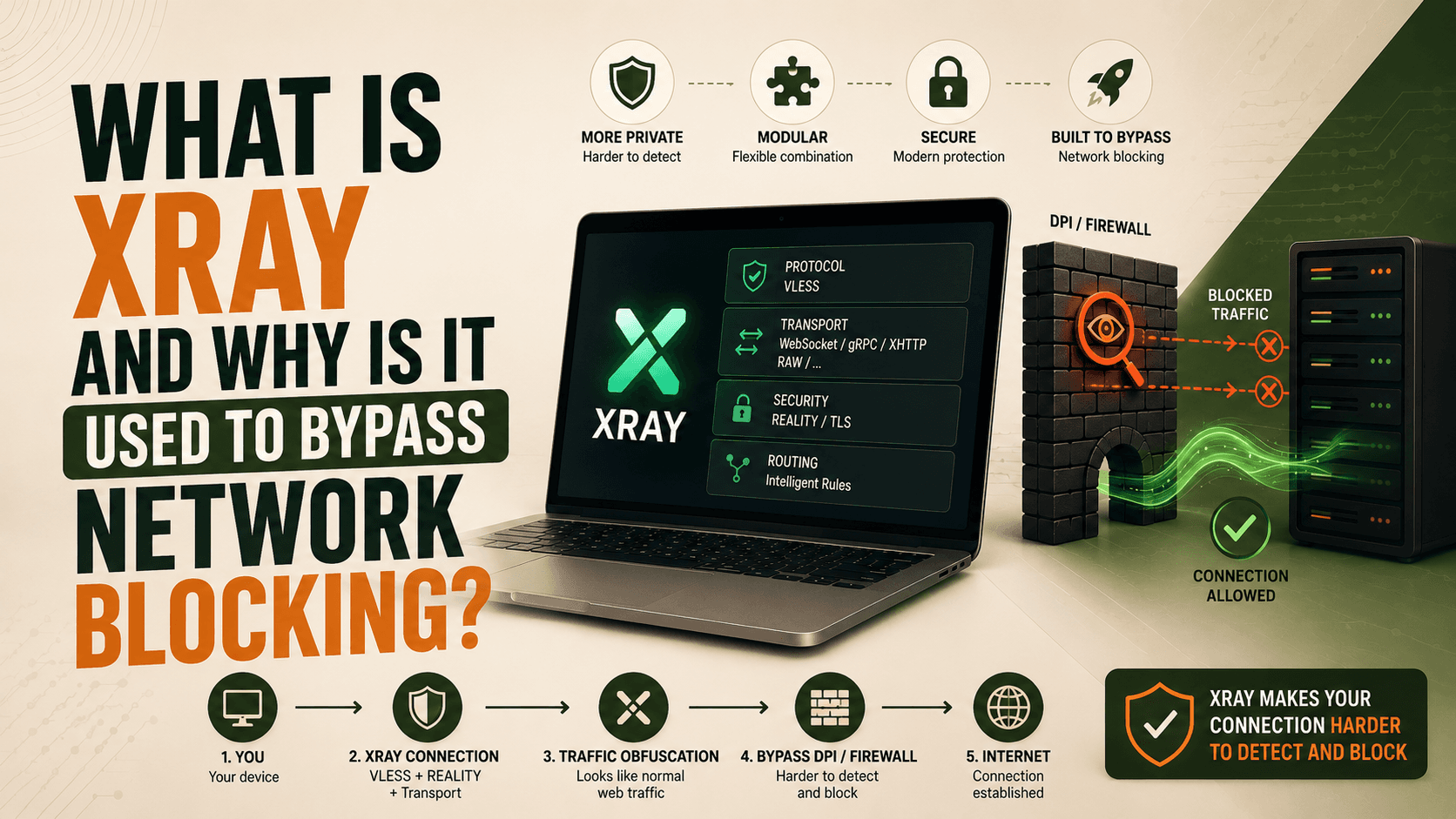
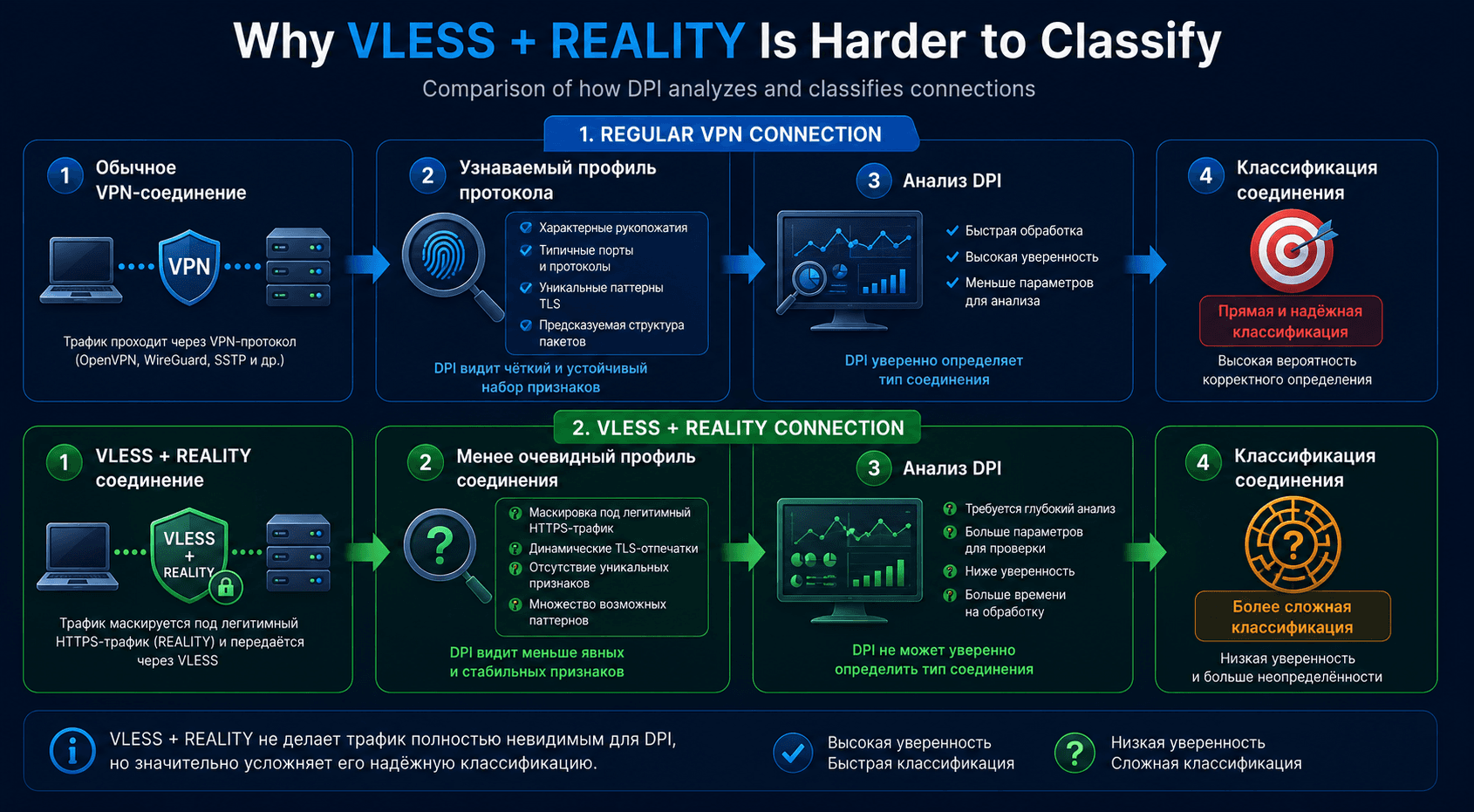
The problem begins on networks that use more advanced filtering. Instead of blocking connections only by IP address or port, these networks may rely on Deep Packet Inspection (DPI) to analyze how traffic behaves.
The filtering system doesn’t necessarily need to decrypt the data. In some cases, recognizing the traffic pattern is enough to classify the connection and block it.
Xray takes a more flexible approach.
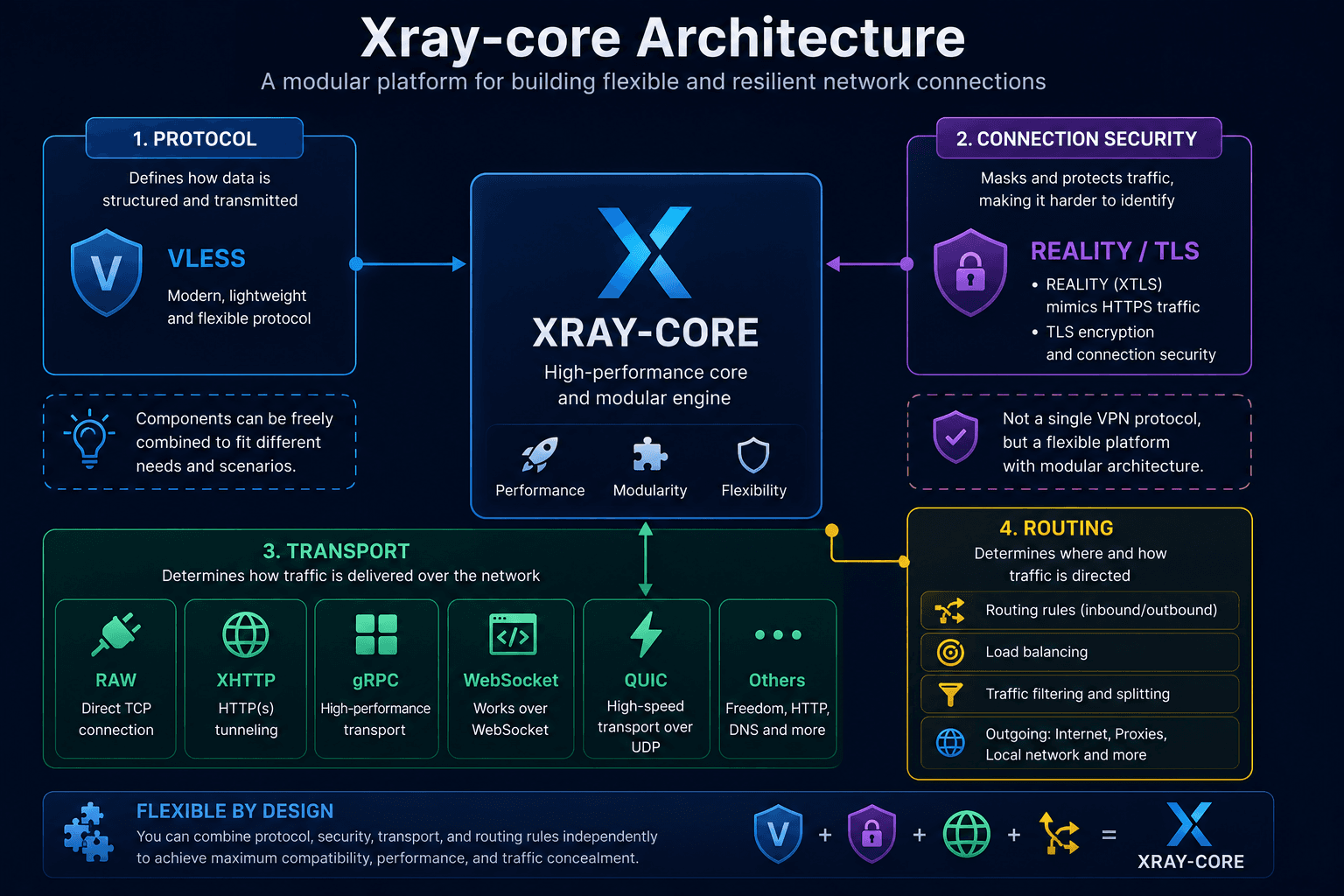
It isn’t a single VPN protocol. Instead, Xray-core is a platform that can combine different proxy protocols, transports, routing rules, and connection security mechanisms.
This modular design makes it useful in environments where standard VPN connections are unstable or easier to identify.
What Is Xray-core?
Xray-core is a networking platform designed for proxy connections and advanced traffic routing.
Its main advantage is modularity.
Instead of using one fixed combination of protocol and transport, administrators can configure different components separately:
- proxy protocol;
- transport;
- transport security;
- routing rules.
As a result, one Xray configuration may behave very differently from another.
This flexibility is one of the main reasons Xray is commonly used in networks where conventional VPN protocols encounter active filtering or blocking.
VLESS: A Lightweight Protocol Used with Xray
VLESS is one of the most widely used protocols in the Xray ecosystem.
It is designed as a lightweight, stateless transport protocol between an Xray client and server.
Unlike VMess, VLESS doesn’t depend on system clock synchronization and uses UUID-based authentication.
VLESS itself should not be treated as a replacement for TLS encryption. Instead, protection is provided separately through the transport layer, using technologies such as TLS or REALITY.
This separation keeps the protocol relatively simple while allowing the transport and security method to be configured independently.
What Is REALITY?
REALITY is a transport security technology used in the Xray ecosystem.
It can be used in certain configurations instead of a traditional TLS setup and is designed to make encrypted connections more difficult to classify in networks with active filtering.
That doesn’t mean REALITY makes traffic completely invisible.
Any obfuscation or traffic-masking technology exists in an ongoing competition with network analysis systems. Its effectiveness depends on the client, server configuration, network conditions, and filtering methods being used.
A more accurate description is that REALITY can make reliable traffic classification more difficult.
VMess Still Exists, but VLESS Takes a Different Approach
VMess was historically one of the core protocols in the V2Ray and Xray ecosystems.
It uses its own protocol structure and differs significantly from the more lightweight VLESS design.
It would be inaccurate to say that VMess is always easy to detect. Still, much of the recent development around Xray has focused on VLESS and related technologies.
VLESS also avoids some of the architectural requirements of VMess, including its dependency on synchronized system time.
Choosing between the two should therefore depend on compatibility and configuration requirements rather than on the assumption that one protocol is universally undetectable.
Why the Transport Layer Matters
The proxy protocol is only one part of the connection.
Xray separates the application-level protocol from the method used to carry traffic across the network.
Depending on the configuration, transports may include technologies such as:
- RAW;
- WebSocket;
- gRPC;
- XHTTP;
- other supported transport options.
Transport security can then be configured separately using TLS or REALITY.
This makes it possible to adapt the connection to different network environments.
However, using an HTTP-based transport doesn’t automatically make proxy traffic indistinguishable from a normal website. DPI systems may analyze packet sequences, connection behavior, timing, and other characteristics beyond the transport name itself.
For a deeper explanation of these techniques, see our guide to Deep Packet Inspection (DPI).
Where Hysteria2 Fits In
Hysteria2 is often mentioned alongside Xray, but technically it is a separate project.
It is a proxy solution built on QUIC and is designed to handle both TCP and UDP traffic, including connections affected by packet loss or unstable network conditions.
Because QUIC runs over UDP, Hysteria2 behaves differently from TCP-based proxy and VPN technologies.
That can be an advantage on some networks and a limitation on others.
If a network heavily restricts or blocks UDP and QUIC traffic, Hysteria2 may also have difficulty establishing a connection.
For that reason, Hysteria2 is better understood as an alternative transport approach rather than as a newer version of Xray.
Why Xray Is Harder to Describe with a Single Signature
Xray doesn’t have one universal traffic profile.
The way a connection behaves depends on several components:
- the selected protocol;
- the transport;
- the security layer;
- routing rules;
- the overall configuration.
This modularity distinguishes Xray from systems where most connections follow nearly the same pattern.
It doesn’t mean Xray is impossible to detect or block.
Instead, filtering systems may need to account for a wider range of possible configurations and analyze each connection more deeply.
In practice, effectiveness depends just as much on configuration quality and network conditions as on the technology itself.
When Xray Is Actually Useful
Xray is particularly useful in networks where standard VPN connections are unstable or affected by active filtering.
Its main strength is flexibility.
Administrators can adjust the architecture of the connection without replacing the entire networking stack each time conditions change.
For ordinary users, understanding every combination of VLESS, REALITY, and transport options usually isn’t necessary. These decisions are more relevant to VPN providers and server administrators who need to adapt their infrastructure to specific network conditions.
If OpenVPN, SSTP, or another standard protocol already works reliably, switching to Xray simply because it is newer may not provide any practical benefit.
What to Remember
Xray is not a single VPN protocol and not a universal invisibility technology.
It is a flexible platform for proxying and traffic routing that supports different protocols, transports, and security mechanisms.
VLESS handles communication between the Xray client and server. REALITY can be used as one option for transport security. Hysteria2 follows a different architecture and is a separate QUIC-based project.
The main advantage of this approach is adaptability.
Instead of relying on one fixed connection model, the infrastructure can be adjusted for different network conditions.
But no technology provides guaranteed protection against Deep Packet Inspection. As traffic-masking techniques evolve, network filtering and classification systems continue to evolve as well.