VPN Obfuscation Techniques: How VPN Traffic Is Disguised
Learn how VPN obfuscation works, why encrypted VPN traffic can still be detected, and how modern VPN protocols make traffic harder to classify.

Paul Jackson
Technology editor
VPN traffic used to be relatively easy to recognize.
A user connected to a VPN, the IP address changed, and the connection worked as expected.
However, modern networks have become much more advanced.
Internet providers, corporate firewalls, and censorship systems increasingly analyze traffic characteristics instead of only looking at the destination or encrypted content.
They do not always need to decrypt VPN traffic.
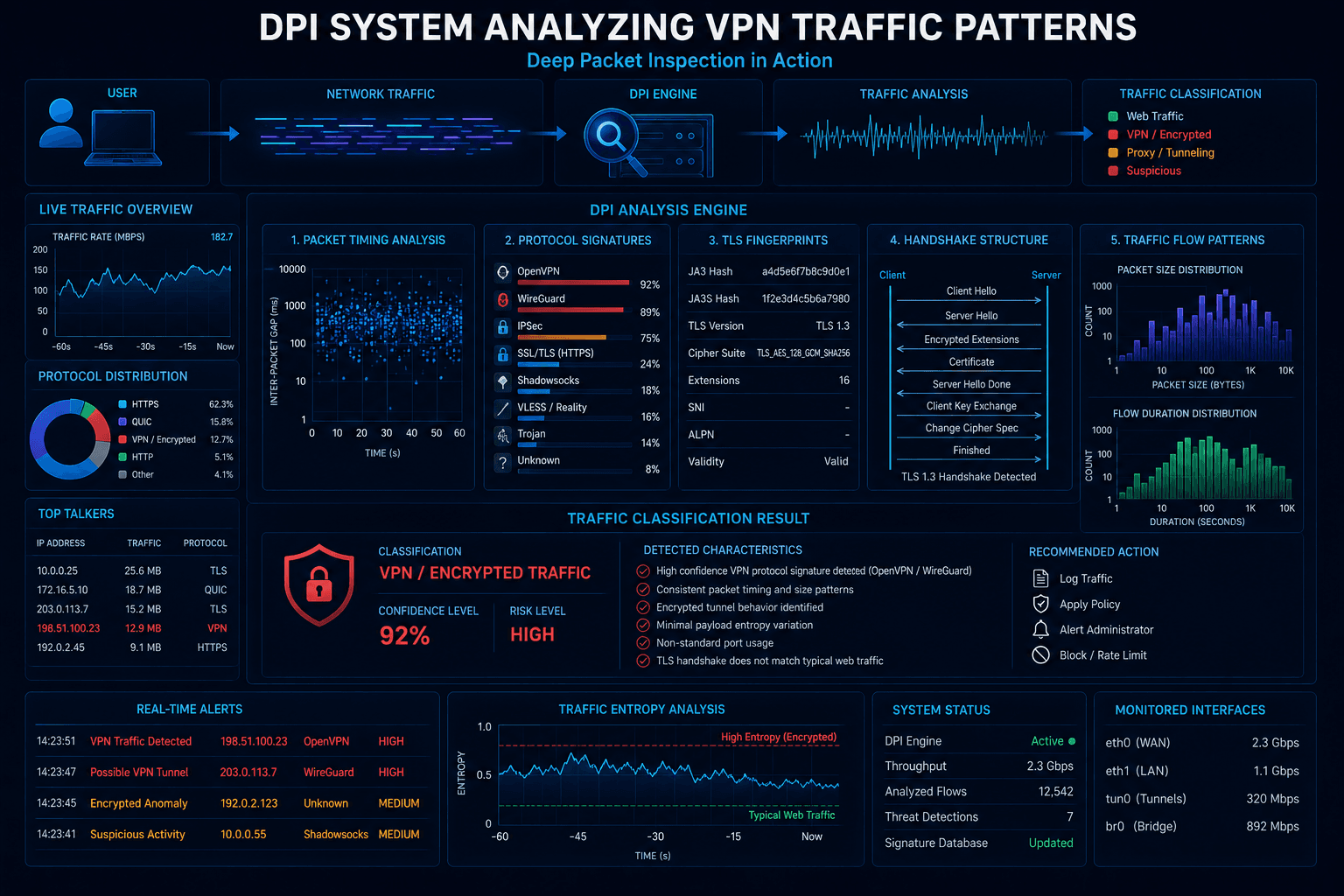
Instead, they can classify connections based on patterns such as:
- packet timing;
- handshake structure;
- protocol signatures;
- TLS fingerprints;
- traffic flow behavior.
This is why the same VPN protocol may work perfectly in one network but become blocked in another.
Modern VPN protocols must solve not only the problem of encryption but also the challenge of making encrypted traffic less recognizable.
Why VPN Traffic Can Be Detected Even When It Is Encrypted
Encryption protects the content of communication, but it does not hide every characteristic of a network connection.
Modern filtering systems use technologies such as Deep Packet Inspection (DPI) to analyze traffic patterns and identify possible VPN connections.
DPI systems may evaluate:
- packet sizes;
- connection timing;
- handshake behavior;
- protocol characteristics;
- traffic flow patterns.
As a result, a connection can remain encrypted while still being recognizable as VPN traffic.
Why Older VPN Protocols Are Easier to Detect
Many older VPN protocols were created primarily for secure communication rather than traffic concealment.
At the time:
- DPI systems were less advanced;
- network filtering was simpler;
- large-scale traffic classification was uncommon.
Modern detection systems can identify certain protocol characteristics much more effectively.
This is especially relevant in environments where VPN filtering is actively used, such as:
- restrictive corporate networks;
- heavily filtered ISPs;
- networks with additional traffic inspection.
OpenVPN: Reliable but Recognizable
OpenVPN remains one of the most widely used VPN protocols.
It is known for:
- strong security;
- stability;
- broad compatibility;
- extensive testing;
- long-term adoption.
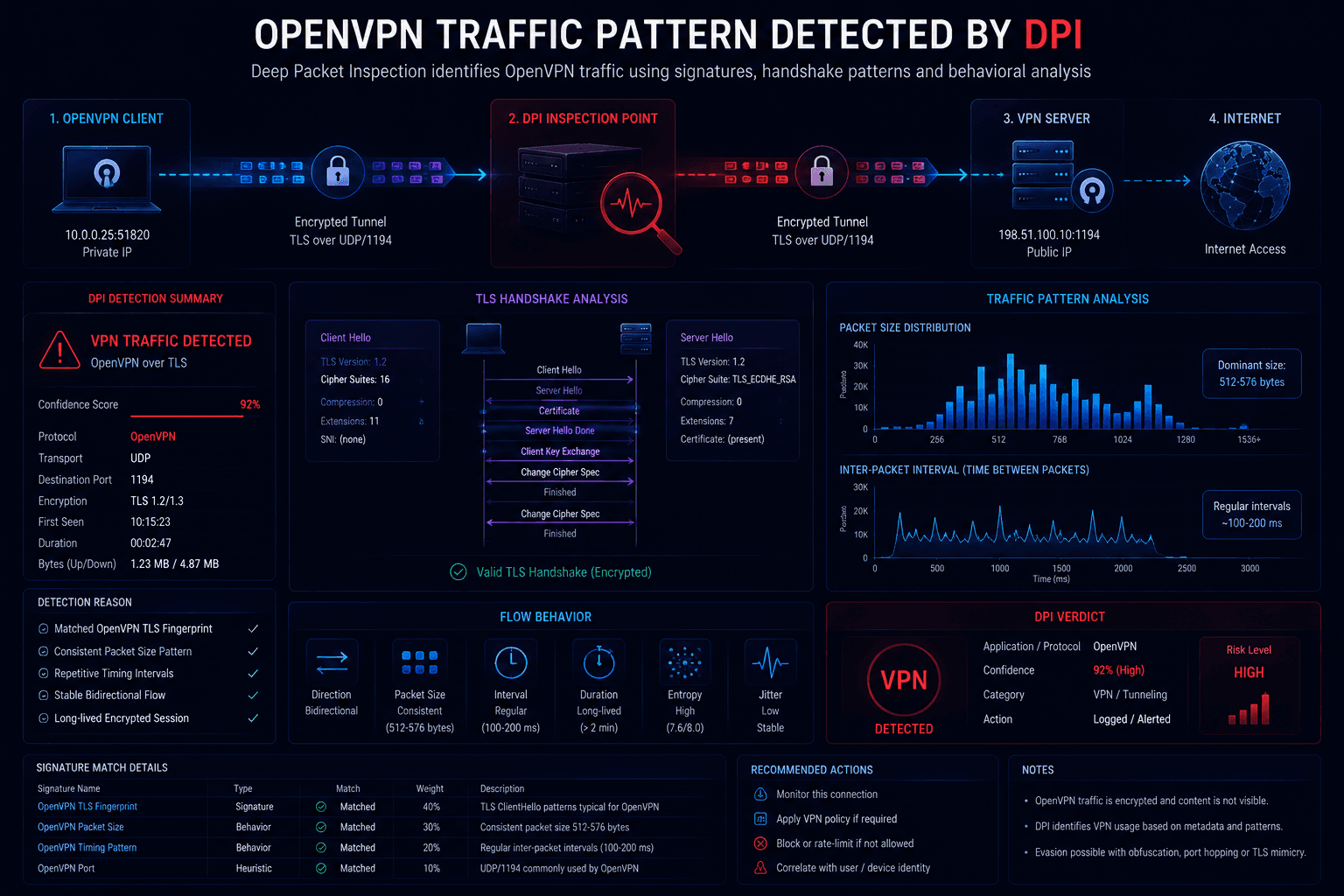
However, OpenVPN traffic can also have recognizable characteristics.
Even when encrypted, it may reveal patterns such as:
- specific TLS handshake behavior;
- predictable connection structures;
- identifiable traffic characteristics.
This does not mean OpenVPN is insecure.
For normal networks, OpenVPN continues to work effectively and remains one of the most trusted VPN solutions.
The main challenge appears in environments where networks actively attempt to classify and restrict VPN traffic.
Why OpenVPN Is Still Widely Used
Despite possible detection challenges, OpenVPN remains popular because it:
- works across many platforms;
- has extensive documentation;
- is relatively easy to configure;
- has a long security history.
For everyday VPN usage, OpenVPN is often still a practical choice.
However, when a network actively blocks VPN protocols, additional obfuscation methods may become necessary.
PPTP and L2TP: Legacy VPN Protocols
Some older VPN protocols are now mainly considered legacy solutions.
The most common examples are:
- PPTP;
- L2TP/IPsec.
PPTP is outdated from both security and technical perspectives.
Its main disadvantages include:
- weaker security compared with modern protocols;
- easy identification by filtering systems;
- limited relevance today.
L2TP/IPsec provides better security than PPTP, but its traffic characteristics can still be recognized by modern network filtering systems.
Today, these protocols are mostly used for compatibility with older devices and legacy infrastructure.
How DPI Changed VPN Detection
Modern filtering systems usually do not attempt to directly read encrypted VPN traffic.
Instead, they rely on statistical analysis.
DPI systems may examine:
- packet size patterns;
- connection timing;
- TLS negotiation behavior;
- session characteristics.
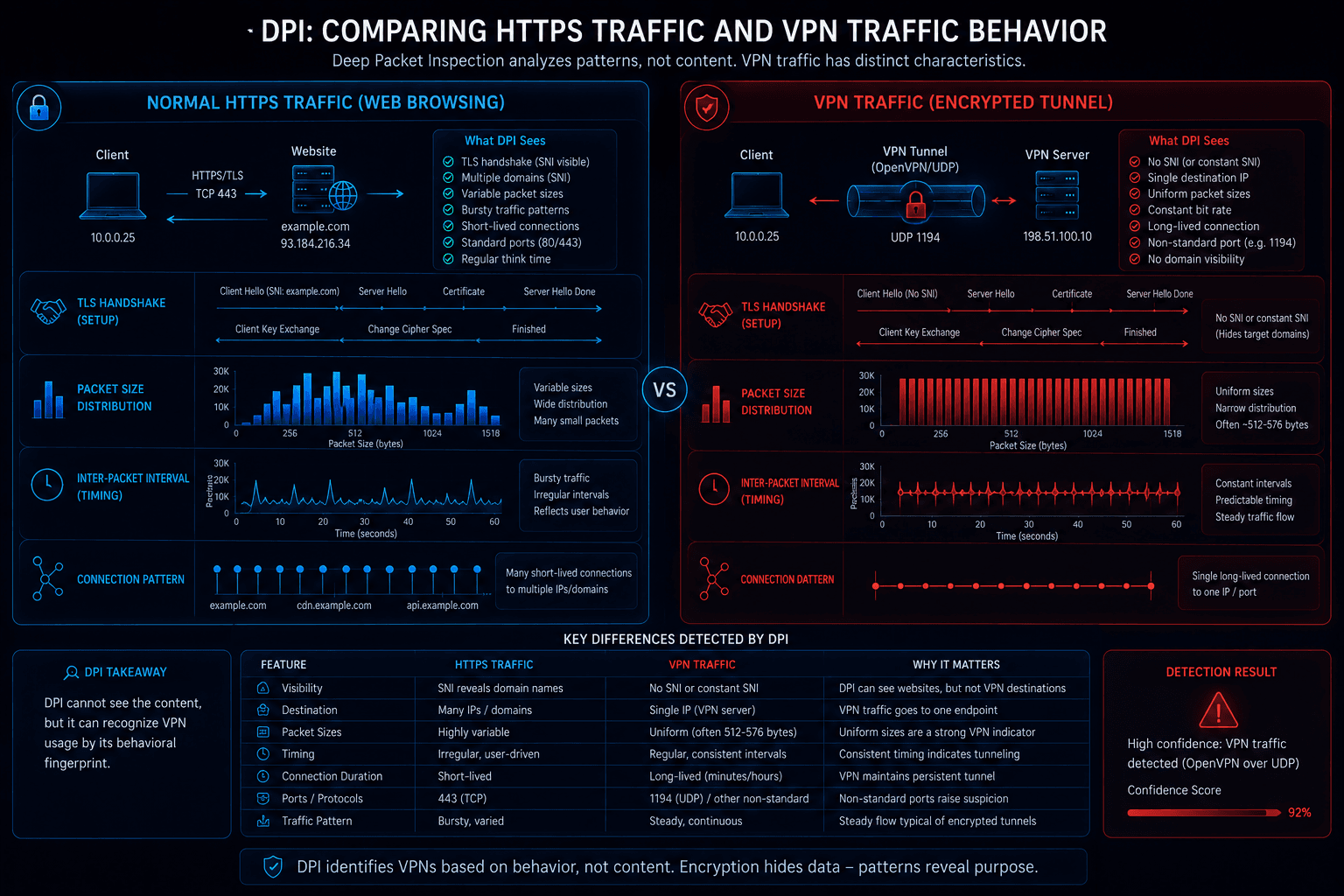
This is why encryption alone is no longer always enough.
A VPN connection can be encrypted and still be identifiable.
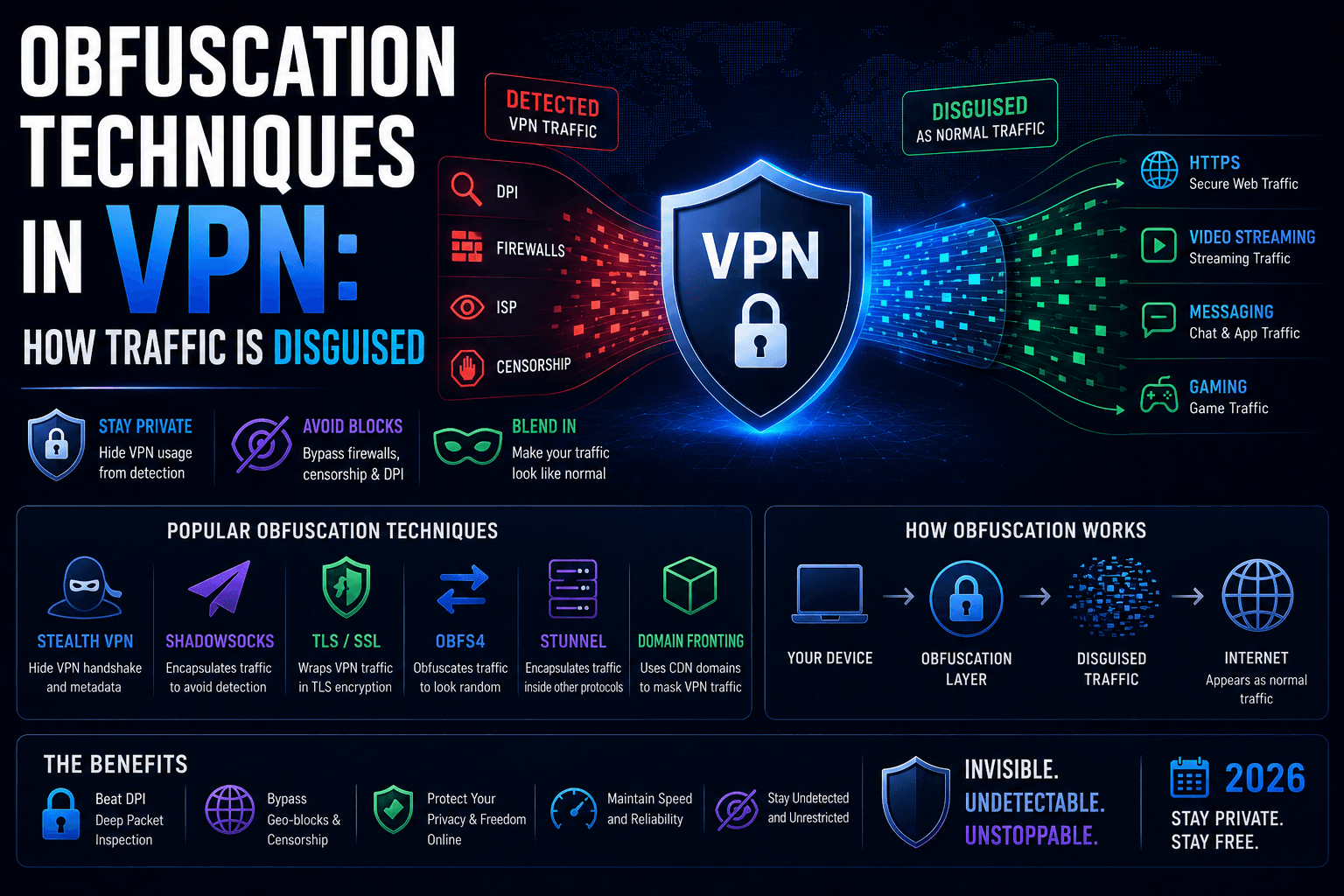
Modern VPN obfuscation techniques focus on making encrypted traffic resemble ordinary internet traffic, especially regular HTTPS connections.
SSTP: Hiding VPN Traffic Inside HTTPS
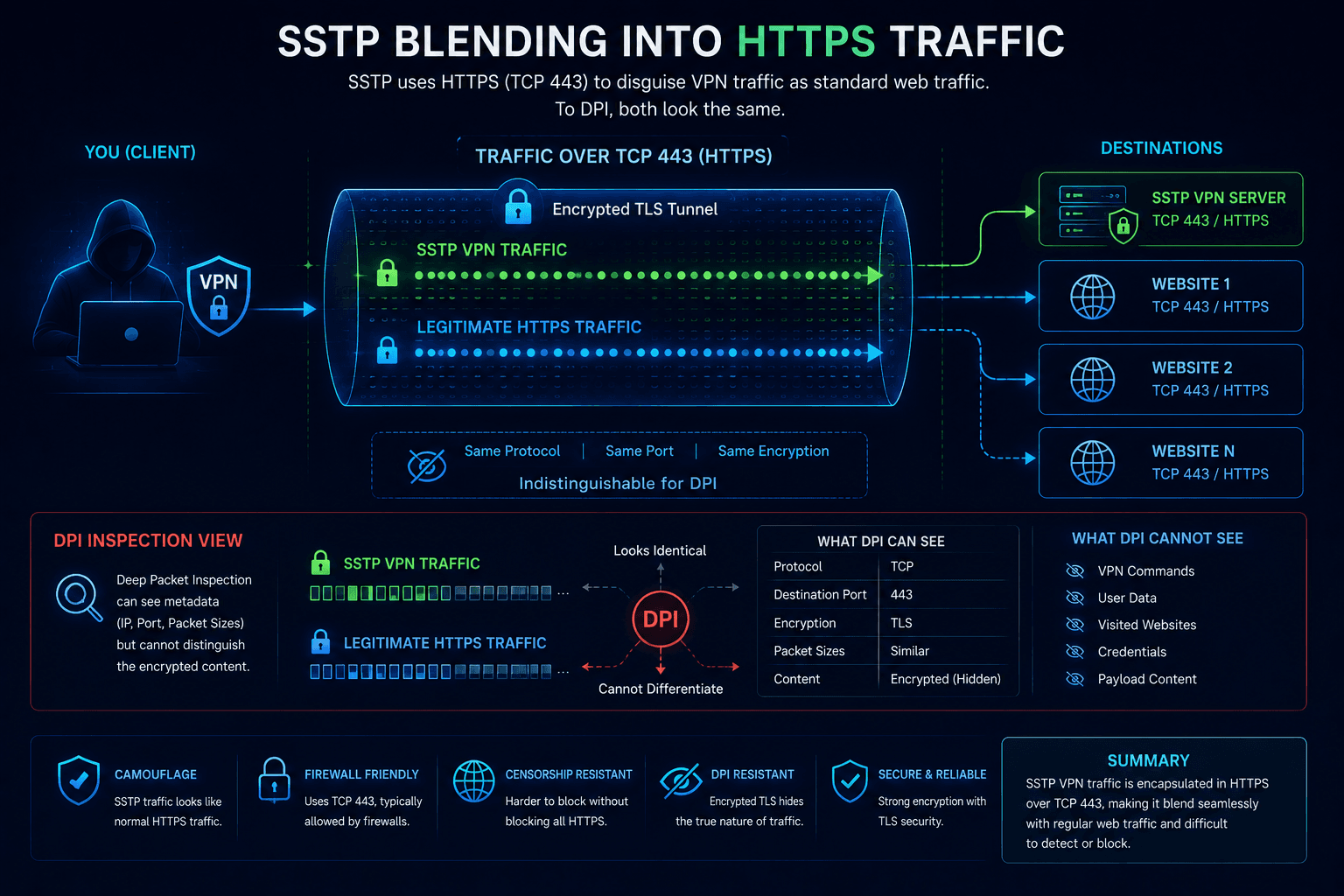
SSTP (Secure Socket Tunneling Protocol) became popular because it transfers VPN traffic through HTTPS.
More specifically, it uses:
- TCP port 443.
This is the same port used by most secure websites.
The practical advantage is simple:
Blocking all traffic on port 443 would also block a significant part of the modern internet.
Because of this, SSTP can work in environments where traditional VPN protocols face stronger filtering.
Why SSTP Remains Useful
SSTP can perform well in networks where traditional VPN protocols are filtered more aggressively.
It can be useful when:
- OpenVPN connections are blocked;
- DPI systems actively classify VPN protocols;
- corporate networks restrict unknown traffic;
- only HTTPS-like connections are allowed.
Its main advantages include:
- traffic that resembles HTTPS communication;
- lower risk of accidental blocking;
- compatibility with restrictive environments.
However, SSTP also has limitations.
Because it operates over TCP, it may introduce:
- higher latency;
- additional overhead;
- reduced performance in some network conditions.
Even with these limitations, SSTP remains a practical option for users who need a VPN protocol that can work in more restrictive environments.
SoftEther: Flexible VPN Traffic Camouflage
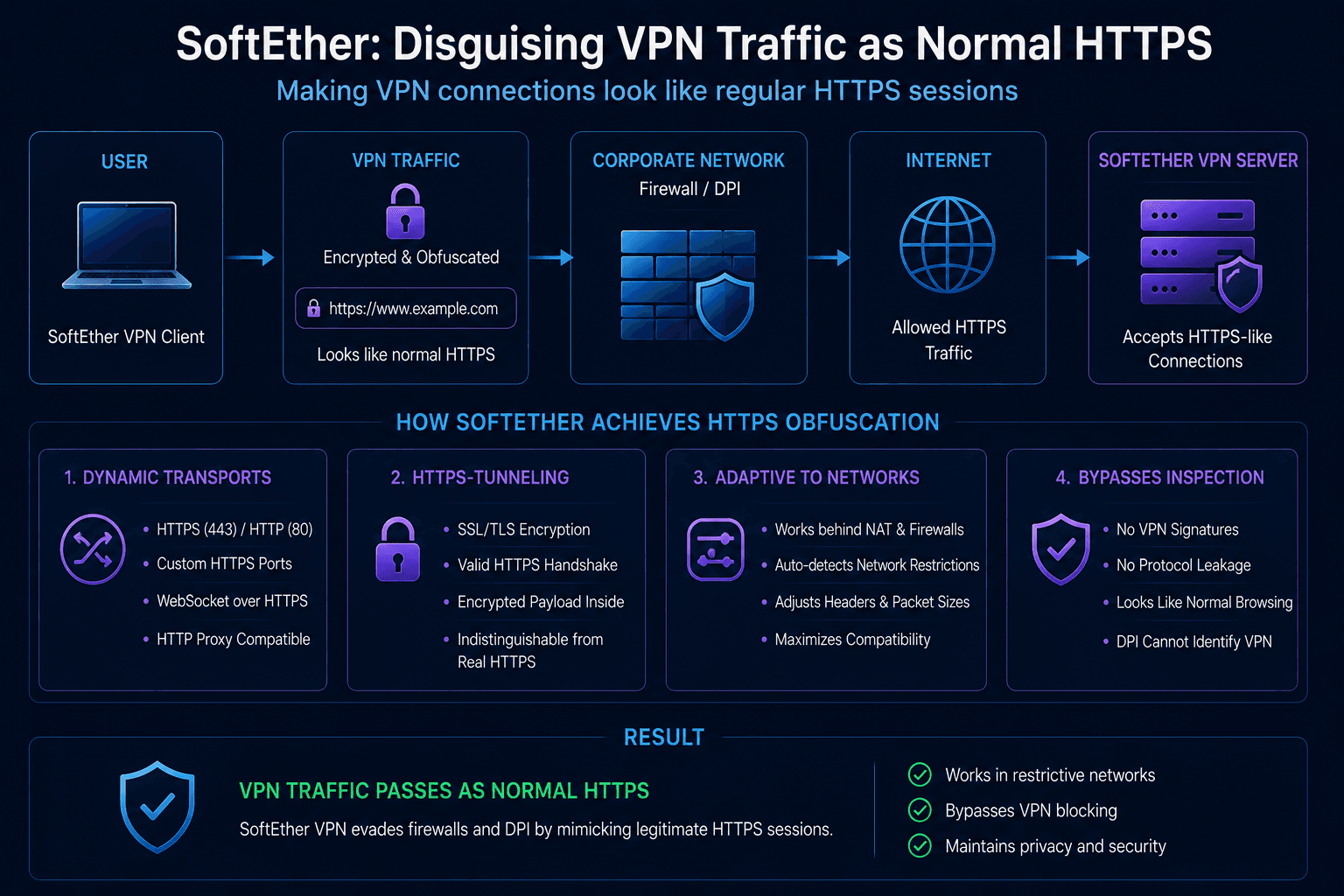
SoftEther is less common among everyday VPN users, but it is technically notable because it was designed with flexibility and resistance to network restrictions in mind.
SoftEther can:
- imitate HTTPS-like traffic;
- use different transport methods;
- operate through restrictive firewalls;
- adapt to complex network environments.
Unlike many traditional VPN protocols, SoftEther places more emphasis on traffic flexibility and network compatibility.
Why SoftEther Can Be Harder to Classify
SoftEther has several characteristics that can make traffic analysis more difficult:
- flexible transport options;
- ability to resemble common encrypted traffic;
- support for different connection methods;
- better adaptation to unusual network conditions.
In heavily filtered environments, SoftEther may perform better than traditional VPN configurations.
However, it also has disadvantages:
- lower adoption compared with OpenVPN;
- less widespread support;
- more complex deployment in some scenarios.
Xray Reality: Modern VPN Traffic Obfuscation
Technologies based on Xray Reality appeared as DPI systems became more advanced.
Modern filtering systems can analyze:
- TLS fingerprints;
- handshake characteristics;
- encrypted session behavior;
- connection patterns.
Simply transferring VPN traffic through HTTPS is not always enough anymore.
Modern systems increasingly evaluate whether encrypted traffic behaves like a normal HTTPS connection.
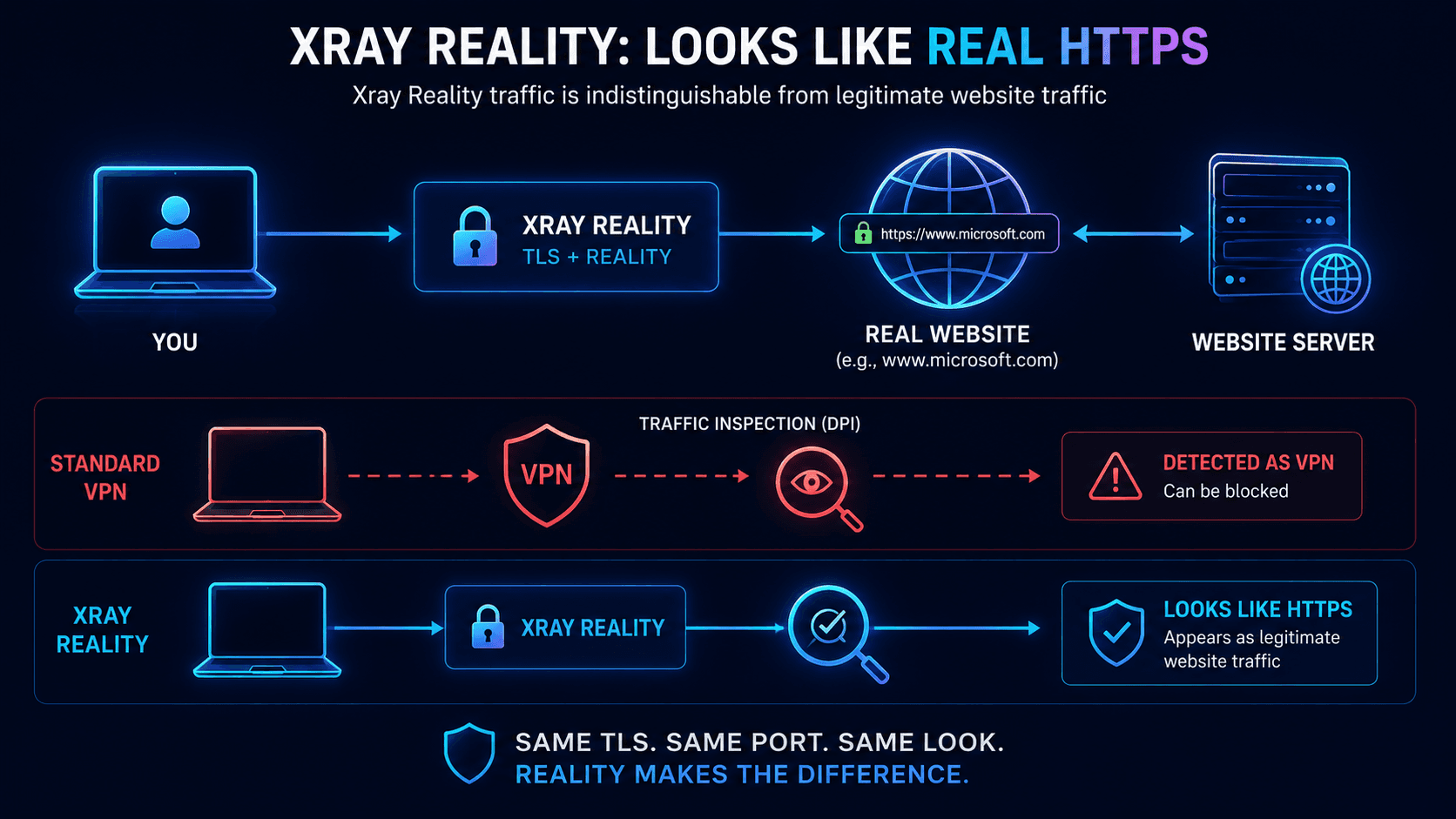
Xray Reality focuses on making VPN traffic resemble legitimate HTTPS traffic as closely as possible.
The goal changes from:
Hide VPN traffic
to:
Make VPN traffic look like normal internet traffic
Why Xray Reality Is Important
Reality-based technologies focus on:
- realistic TLS behavior;
- authentic-looking handshakes;
- reducing static traffic signatures;
- making classification more difficult.
This approach is designed specifically for modern DPI environments.
In restrictive networks, the difference between recognizable VPN traffic and realistic-looking encrypted traffic can determine whether a connection continues to work.
Why No VPN Protocol Stays Invisible Forever
No VPN protocol remains impossible to detect permanently.
Detection technologies continue to evolve.
When a protocol becomes widely used:
- more traffic samples become available;
- detection signatures improve;
- classification models adapt.
This creates a continuous cycle:
- VPN protocols improve obfuscation;
- DPI systems improve detection;
- new techniques appear.
VPN obfuscation is an ongoing technological competition between traffic concealment and traffic analysis.
What Modern VPN Providers Use
Modern VPN providers usually do not rely on only one protocol.
Instead, they combine:
- traditional compatibility protocols;
- stealth-focused protocols;
- HTTPS-based tunneling;
- additional traffic obfuscation methods.
This allows users to choose different connection methods depending on:
- network restrictions;
- ISP behavior;
- firewall configuration;
- local filtering policies.
Services such as WhoVPN support multiple connection approaches, including classic and newer protocols:
- OpenVPN;
- SSTP;
- SoftEther.
Modern Xray-based technologies are also becoming increasingly relevant because of their focus on advanced DPI environments.
Which VPN Protocol Should You Choose?
There is no single best protocol for every situation.
| Protocol | Detectability | Compatibility | Speed | Recommended scenarios |
|---|---|---|---|---|
| OpenVPN | Easier to identify in some DPI environments | Very high | Good | Maximum compatibility |
| SSTP | Lower risk of blocking because it resembles HTTPS | High in restrictive networks | Moderate | Restricted networks |
| SoftEther | More difficult to classify due to flexible transport options | Medium | Depends on configuration | Complex network environments |
| Modern obfuscation technologies | Designed to reduce recognizable traffic patterns | Depends on implementation | Depends on configuration | Advanced DPI environments |
For Maximum Compatibility
OpenVPN remains a strong option because of its stability, security history, and wide support.
For everyday VPN usage, it continues to be one of the most practical choices.
However, when network restrictions become more aggressive, additional obfuscation methods may provide better results.
For Restrictive Networks
SSTP and SoftEther may provide better results when traditional VPN traffic is filtered.
These protocols focus on improving compatibility in environments where:
- VPN protocols are actively blocked;
- DPI systems classify traffic patterns;
- firewall rules restrict unknown connections.
For Advanced Filtering Environments
Modern obfuscation technologies are designed specifically for situations where traffic classification systems are more advanced.
Their goal is not only to encrypt traffic but also to make encrypted connections resemble normal internet activity.
The best choice depends on the network environment, not only on the protocol itself.